


What the Top 1% of College Applications Actually Look Like; And Why Indian Students Keep Missing It
- Ishita Banerjee

- Mar 30
- 8 min read
Updated: Mar 31

The numbers are nearly identical. The SAT scores are nearly identical. The grades are nearly identical. So why do some students get in and most don't, and what does it have to do with being Indian?
Every year, thousands of Indian students submit applications to Harvard, MIT, Stanford, and their peers with profiles that look, on paper, formidable: a 1540 SAT, a 97% boards score, 8 AP courses, student council membership, classical dance for ten years, a few Olympiad certificates. Every year, the vast majority of these students receive rejections — and are genuinely bewildered by them.
The confusion is understandable. Because by the numbers, these students have done everything "right." But that's precisely the problem: they've done everything that looks right, not everything that is right for the hyper-selective admissions game at America's most elite universities.
This piece pulls directly from Common Data Sets, real admit profiles, and what admissions officers have said publicly about what separates the top 1% of applications from everyone else. The findings are uncomfortable — but they're also actionable.
The Numbers: What Top Admits Actually Look Like
Let's start with the raw data, because it's important to understand what the floor looks like before we talk about the ceiling.
Class of 2029 (2024–25 cycle)
4.18%Harvard accept rate
4%Stanford accept rate
3.9%Princeton accept rate
According to Harvard's 2024–25 Common Data Set, the admitted Class of 2029 had an average high school GPA between 3.9 and 4.0, with 72.4% of admitted students carrying a 4.0 GPA. A striking 94% graduated in the top 10 of their high school class, and 99% were in the top quarter.
At Stanford, the picture is near-identical. The average unweighted GPA for admits in the 2024–25 cycle was 3.94, with 73.3% of admitted students having a perfect 4.0. The middle 50% SAT range sat between 1510 and 1570, with ACT scores between 34 and 35. Stanford considers an extraordinary 97.8% of its admits to have graduated in the top 10% of their class.
At Harvard, SAT scores for the Class of 2029 sat in the middle 50% range of 1510–1580, with ACT equivalents of 34–36. Stanford has now returned to requiring standardised tests for the class of 2030, and at Harvard, testing was reinstated for the Class of 2029 — the first cohort required to submit scores since the pandemic.
"Grades are your baseline requirement — the price of admission to even be considered. Extracurriculars are what differentiate you once you've cleared that academic bar."
— Jamie Berger, College Admissions Expert, quoted by Great College Advice
What this means in practice: at MIT, an admissions officer once put it plainly — MIT receives applications from students with the highest possible achievements, grades, and scores. The only way they distinguish them from each other is extracurricular activities.
This is the core insight that most Indian applicants miss entirely.
The Myth of the Perfect Score
The Indian education system trains students to optimise for numbers, i.e. percentage points, ranks, marks. It is excellent at producing students who score very well on standardised measures. But here is the brutal truth about elite US admissions: a 1580 SAT is not impressive. It is expected.
Harvard received 47,893 applications for the Class of 2029 and admitted 2,003 students- a 4.18% acceptance rate. Among those 47,893 applicants, a very large proportion had near-perfect academic credentials. Perfect or near-perfect SAT scores, top-decile grades, rigorous coursework. The score is a filter, not a differentiator. Clearing it means you are in the room. It does not mean you get the chair.
Stanford's Common Data Set explicitly rates standardised test scores as only "considered" which is considered a lower weight category than "very important," which is reserved for GPA, course rigour, essays, and recommendations.6 The academic record matters enormously. But once you're past the academic threshold, something entirely different takes over.
What the Top 1% Actually Have: The Depth Principle
The single most consistent feature of successful applicants to ultra-selective schools is not breadth — it is concentrated, demonstrable depth in one or two areas, paired with a narrative that connects those areas to who they are and where they are going.
Admissions consultants call this the "spike." It is, at its best, not a manufactured strategy but a genuine reflection of passionate pursuit — a student who has gone so far into one domain that they have created something, published something, competed at a national or international level, or built something with real-world impact.
Tier 1 achievements: nationally ranked athletic or academic competition, international Olympiad qualification, a published paper, a working app with thousands of users, a meaningful startup which are rare, hard to fake, and extremely powerful.


For the top 20 schools, a competitive application typically needs at least one or two Tier 2 achievements and a Tier 1 if possible.7
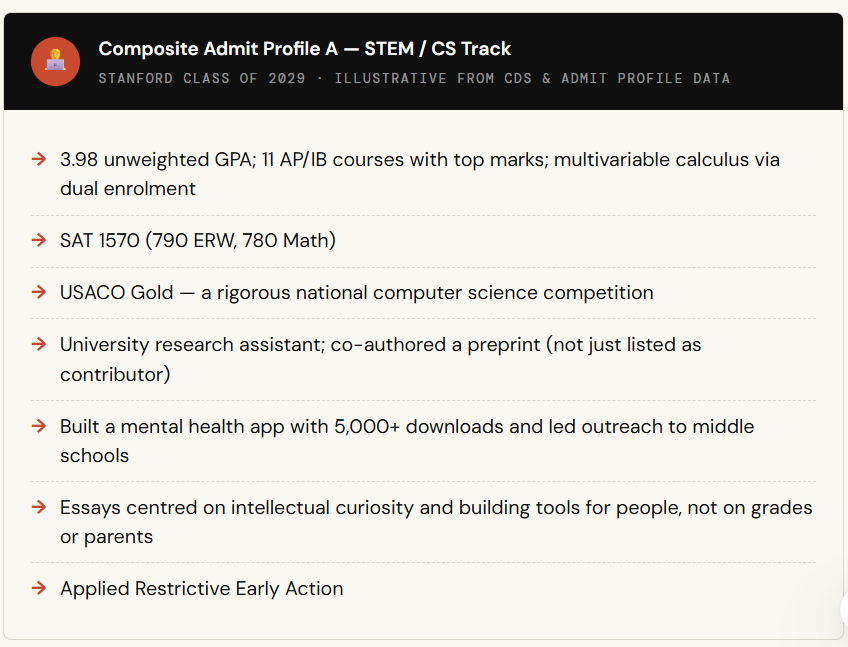
Here is what two actual admitted Stanford profiles from the 2024–25 cycle look like, drawn from publicly available admit profile data:
Composite Admit Profile B — Humanities / Policy Track
Stanford Class of 2029 · Illustrative from CDS & Admit Profile Data

Notice what both profiles share: a coherent, specific narrative that runs through grades, activities, and essays. And notice what neither profile has: a laundry list of clubs, a classical arts recital listed as an extracurricular, or a vague community service activity with no measurable outcome.
Why Indian Students Keep Missing This
This is the uncomfortable conversation. And it is one that admissions professionals who have worked with Indian applicants for decades have been having openly for years.
Ivy Coach, a prominent US-based admissions firm with over 30 years of experience, has written directly about this pattern: Indian applicants too often conform to a stereotype that causes admissions officers to write them off.
They apply listing tennis and classical dance, showing an exclusive affinity for STEM, and referencing reverence for their grandparents. These characteristics appear in the vast majority of Indian student applications — and they adversely affect chances precisely because they are so common.
This is not bias against Indians. It is a consequence of a herd behaviour that collapses individual identity into a recognisable type. Admissions officers at Harvard, Stanford, and MIT read thousands of applications per cycle. When the same profile — 95% boards, STEM interest, classical dance, Olympiad participation, IIT coaching in the background — appears again and again, none of those profiles feel like a person. They feel like a category.
The Five Traps Indian Applicants Fall Into
The Score Trap
Optimising for a 1600 SAT when a 1540 would already clear the filter, at the cost of time that could have gone into building something remarkable. The score matters. Perfecting it past a threshold is a poor return on investment.
The STEM Monoculture Trap
Applying as a STEM student because "that's what Indian students do" — even when the student's genuine passion is literature, urban design, or policy. Admissions officers notice when the academic and personal narrative don't align. Worse, STEM is the most crowded track for Indian applicants.
The Résumé Padding Trap
Listing 10 activities at Tier 3 or Tier 4 — participation in clubs, attendance at summer programmes, membership without leadership. Five clubs with no results lose, consistently, to a single activity with real-world impact.10 Width without depth signals effort without commitment.
The Essay Template Trap
Writing essays about the importance of education, about learning from a grandparent, or about overcoming a difficult exam; these narratives are sincere but statistically indistinguishable from thousands of other applications. The essay is the one place on the application where your voice can be entirely your own. Most Indian students borrow someone else's.
The Late-Start Trap
Beginning to think strategically about the application in Grade 11. At ultra-selective schools, the most compelling extracurricular profiles were built over three or four years — not assembled in 18 months. Depth takes time. A student who began a community initiative in Grade 9, developed it through Grade 12, and has something to show for it is infinitely more compelling than one who joined the initiative in Grade 11.
What Actually Works: Through the Career Forte Lens
The good news — and it is real good news — is that Indian students have access to extraordinary raw material for exceptional applications. India itself is context. A student navigating a complex linguistic, socioeconomic, or cultural environment that most American applicants have never encountered has stories that admissions officers genuinely want to read. The problem is not the life; it is the framing.
⚡ The Core Shift Required
Move from "I am an excellent student who has done many things" to "I am a specific person who has built something, created something, or changed something — and here is the evidence." Excellence is table stakes. Specificity is what gets you admitted.
Concretely, what distinguishes applications that break through:
Original creation over participation. A student who founded something-even something small, demonstrates initiative that no club membership can replicate. A self-published research paper, a working product, a community organisation with documented outcomes, a body of creative work with an audience: these are Tier 1 activities because they are inherently singular.
Authentic cross-disciplinary narrative. The student who bridges domains unexpectedly — who uses computational tools to study folk music traditions, or who applies behavioural economics to improve voter turnout in their neighbourhood — creates an application that is impossible to replicate because the combination is genuinely theirs.
Essays that reveal, not recite. Stanford rates essays as "very important" which means they equal weight to GPA and course rigour. An essay that reads like a college application essay will not move an admissions officer. An essay that reads like a piece of writing by a curious, specific, honest human being will. The threshold question is: could any other applicant have written this? If yes, it needs to be rewritten.
Early Decision and Restrictive Early Action. Applying early is a meaningful strategic advantage that most Indian families underutilise. Harvard's REA acceptance rate for the Class of 2028 was 8.74%, compared to 2.77% for regular decision which is more than three times higher.11 This advantage is real, consistent, and available.
A school list that reflects strategy, not status. The fixation on "Harvard or nothing" is not just emotionally costly, it is strategically a death knell. Many schools in the 15–40 range of the US News rankings are substantially less competitive, provide exceptional education, offer strong merit aid, and lead to the same career outcomes as the Ivy League for motivated students. A well-constructed list increases the probability of attending a school that is actually excellent, not just famous.
A Note on the Larger Context
It would be incomplete to write about Indian students and US admissions in 2025 without acknowledging the structural headwinds.
F-1 visa denial rates reached their highest level in over a decade during 2023–24, with 41% of applications denied.12
The number of Indian students in the US fell by 13% from 2023 to 2024.13
The current political environment in the US has introduced a layer of uncertainty around OPT, H-1B, and the general welcome extended to international students.
These are real problems. But they do not change the underlying logic of what makes an application exceptional. A student who builds an application designed for the top 1% with genuine depth, a coherent narrative, outstanding writing, strategic school selection is bound to be spoilt with options. Options at elite American universities, yes, but also at outstanding institutions in the UK, Canada, Europe, and Singapore that now actively recruit the best Indian talent.
The skills required to craft a top 1% application — self-knowledge, the ability to articulate what you have built and why it matters, intellectual ambition that goes beyond grades — are not just admissions tools. They are life skills. The process of building them, done right, is worth pursuing regardless of where it leads.
Sources & References
Harvard Common Data Set 2024–25. CollegeVine analysis. CollegeVine Blog, 2025
Stanford Common Data Set 2024–25. CollegeVine analysis. CollegeVine Blog, Dec 2025
Harvard Common Data Set 2024–25 via CollegeVine. SAT middle 50%: 1510–1580; ACT 34–36.
Jamie Berger, veteran admissions expert, quoted in Great College Advice, Jan 2026
Harvard acceptance rate: 4.18% for Class of 2029. AdmissionSight, Mar 2026
Stanford Common Data Set 2024–25 — factor weighting. Cosmic College Consulting, Aug 2025
Work with Career Forte to build a profile that stands out in hyper-competitive admissions pools — from narrative to school list to essays.


Comments